I agree with @Foxalabs. I can understand why you would want it to appeal to more people but also understand that it is only a voice and each one they create costs money. I don’t believe this is a necessary approach to the situation.
I’m unable to hear what color people have, I actually imagined 2 of these voices as comming from non caucasian speakers 
Do we know who the voice actors are?
I don’t believe we have been given information on the voice actors. It would be cool if they could give us that info.
I totally get what @anon22939549 is saying. @anon22939549 is proposing that OpenAI should offer an African voice or accent option, so that folks in Africa can relate to the model better when it speaks. The accent is a big part of it. I agree with this idea because for some Africans, the only hurdle might be struggling with the accent. So, having an African accent option would be a really thoughtful move by OpenAI.
Thanks @wwwarmy38!
I think African voice/accents are a great idea too, it’s just not exactly what I was referring to.
I realize many of you here are either not American or not in the United States, so let me try to explain.
In the United States, many—but certainly not all—black Americans have a voice which is identifiably black. There is a tone and timbre in their voice which is nearly unique to this subset of black Americans, and it has been studied by academics for years.
Some resources
https://pubmed.ncbi.nlm.nih.gov/7967558/
The Class and Colour of Tone: An Essay on the Social History of Vocal Timbre on JSTOR
Sounding Black or White: priming identity and biracial speech - PMC
Can you recognize the race of the person you are speaking to just by their voice?
This “black voice” is something distinctly different from an accent or a dialect, it’s a difficult-to-describe vocal quality.
It would be wrong and potentially harmful if the only voices we give to our AI companions who will fill the roles of friends, confidant, teacher, mentor, and advisor all, uniformly, sound “white.”
Because representation matters.
Beyond that there absolutely should eventually be voices with accents and speech patterns for other major groups throughout the world.
The fact is kids who may turn to the AI for advice and information deserve to be able to hear a voice that sounds like them or their parents.
I feel strongly enough about this that I’m going to tag in @logankilpatrick.
Too often racial biases get baked into models because the models are only trained on the de facto default—white.
See:
And others.
The only way to combat this is to proactively take measures to ensure fair and equitable representation.
OpenAI has demonstrated 5 voices, the fact there isn’t one of them that is “black” is a huge misstep in my opinion.
I hope this is something OpenAI considers, engaged with the black community, and acts on soon.
On the subject of representation, I’m a bit dissappointed to hear that all the voices are gendered. I don’t like pronouns for myself and I tend to think of GPT as having no gender. It’s… pretty jarring (at least my my ear) to hear a strongly male or female voice for something that is intrinsically neither. Additionally, for a tool which has built in safety parameters that remind the user that it is not sentient, it seems like having a gender-free/gender-neutral or even a flat or “robotic” voice would make sense to underline that distinction.
It is a fabulously exciting feature, don’t get me wrong! I’m blown away by the quality of the voices, it’s far beyond the pacing and subtleties of the speech models I have used. I just find it so completely at odds with how I view the “voice” of GPT that I don’t see myself using it. (I do use some other speech engines with GPT to have audio conversations and I do find it a useful feature, but I had a wide range of options there and I select for the most neutral voice there).
I agree 
I do believe there will be other voice options in the near future. It’s definitely something that needs special attention. I can definitely imagine some backlash if they release a voice that seems to misrepresent any given minority.
I am sorry I do not understand what you are saying, how can you not sound like a gender? You need to remember that real people create the voices that are used making it not possible to have a “gender-free/gender-neutral” voice. I can understand a robotic voice but having a real person do the voice acting sounds much better.
I understand your point but I also believe it is important not to always follow what the culture deems acceptable and to just make your product as amazing as possible.
These voices are impressive, truly. Loving Juniper. A lot of these high-end AI voices tend to drift into monotony and become difficult to listen to. So much that competitors suggest a narrative-style of prompting just to invoke any sort of emotion:
For instance, you can use dialogue tags to express emotions, such as
he said, confused, orhe shouted angrily. These types of prompts will help the AI understand the desired emotional tone and try to generate a voiceover that accurately reflects it. With this approach, you can create highly customized voiceovers that are perfect for a variety of applications.
Was really hoping to see some examples in different languages though
It would make since that they are starting with English as that is their main user base but other languages such as Spanish and Russian would be nice.
Agreed. Hopefully we can start to test these out ourselves soon. I have been using/listening/paying a lot for a narrator of famous animal documentaries and he just kicks butt in Spanish so my hopes are high 
Agreed, although I wouldn’t count on our favorite animal documentary narrator speaking Russian any time soon 
Good question! Voice tone and register comes down to the physicality of the structures of the person speaking. Blending voices and making pitch adjustments allow for the creation of voices that are neither clearly male nor female.
There is an NPR piece called “Meet Q, The Gender-Neutral Voice Assistant” that talks about this! They have a sample you can listen to that shows one result of this approach.
Real humans are sampled, but postprocessing of the audio recordings allows for the final voice(s) to be tweaked and altered.
The pitches and timbres of the default voices which were just released make them easy to identify as male or female. Voices in the midrange, however, with characteristics of both ends of the specturm, are less binary and would live in that middle ground.
The general gendering of virtual assistants as female has cultural and social implications and so providing male voices as well is as good step. Having a non-gendered and less explicitly typically human option would be a nice addition. I don’t view GPT as gendered, so it is just an uncomfortable modality of interaction. And as someone who prefers no gender for themselves, I end up feeling a bit weird about it from that perspective as well.
I thought I’d put a face to the name.
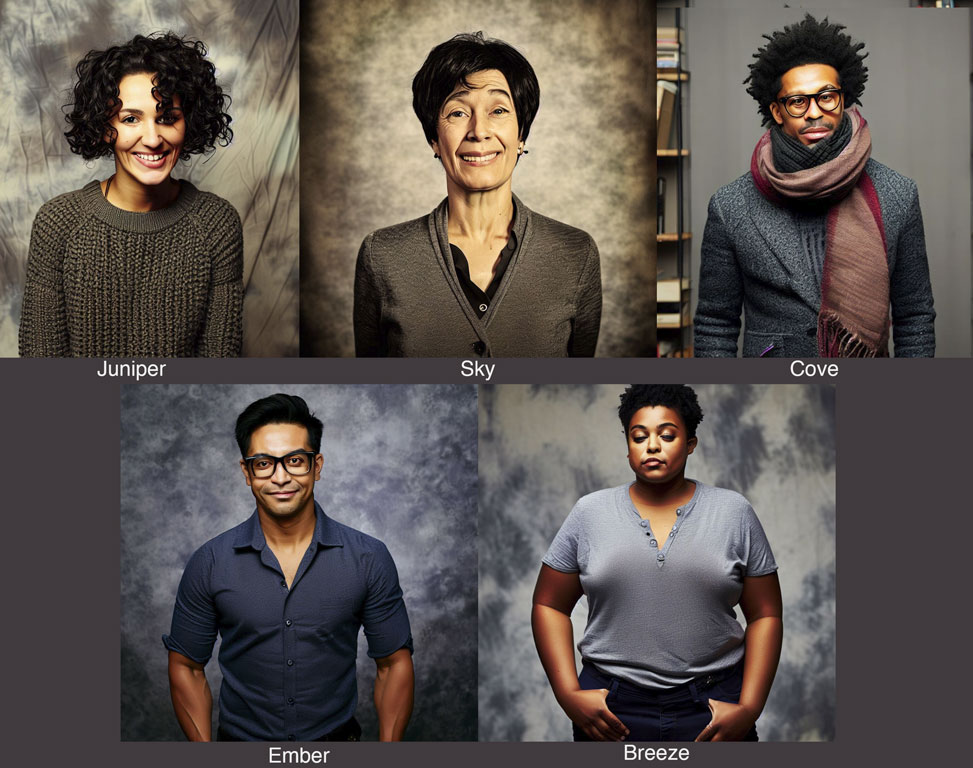
(This is more me throwing away 90% of the candidate AI images as just being too distorted and bizarre, and finally giving up with decent results that aren’t what I pictured.)
An alternative Breeze:
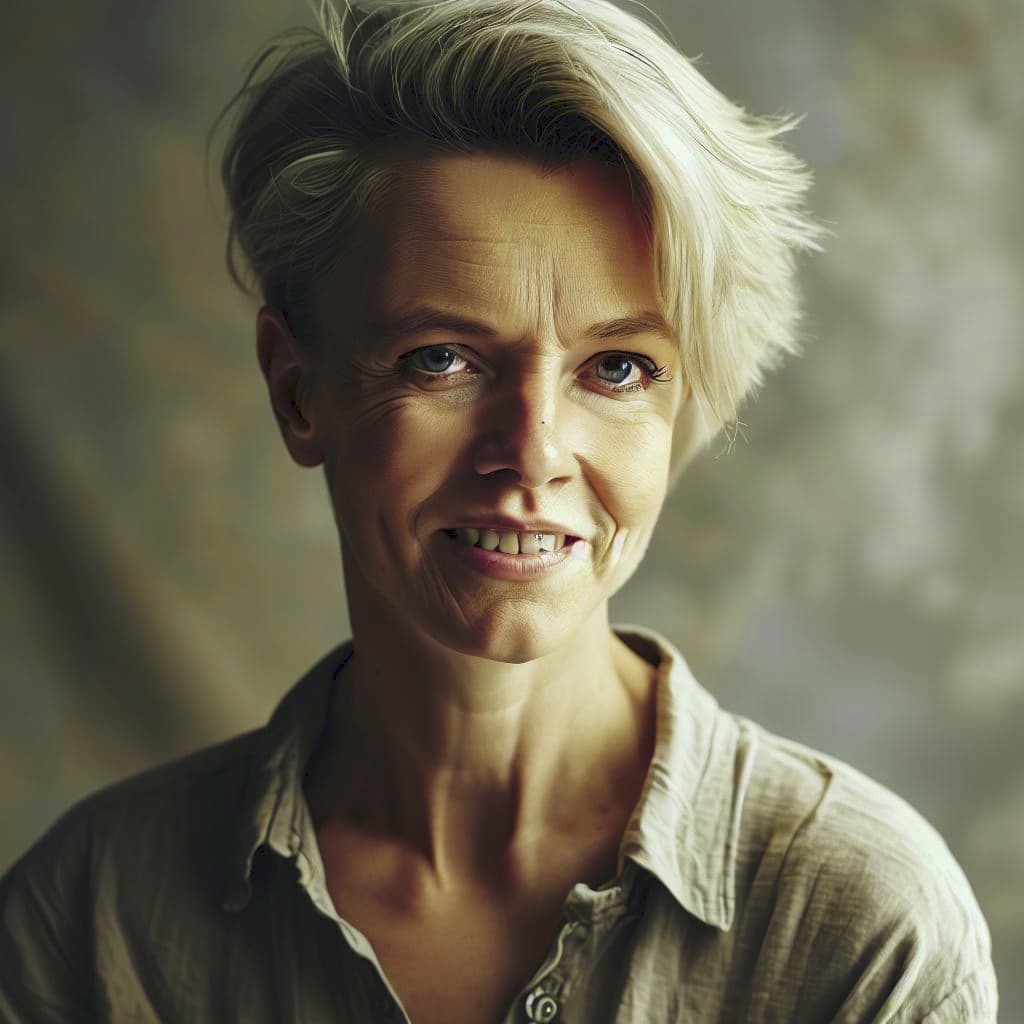
I Like these! The eyes and teeth have gotten a lot better.
I could have confused Ember with a real person.
I think Sky sounds a bit younger. The rest I think can fit to the voices.
If you don’t like those voices just ask ChatGPT to talk different.
I asked ChatGPT voice to talk like “ a funny and cockie Mexican chillando “ so he can tell me funny jokes about Trump .
Then ChatGPT somehow learn my own voice until he / it got confused
I see my previous post was hidden. It seems the pragmatic truth has become intolerable. I now officially commit to creating my own AI system. We will start from basic principles. I wish ChatGPT a great future, good luck to all the developers.