As far as images go, AI will produce what you prompt it to do. Here is what a couple of one word prompts produced awhile back:
Depression

Psychotic

Simplicity
And yet you outperform me every time, but I’m glad to inspire so we get to enjoy your creations
I’m not outperforming, not competing either, just looking for seeds of creative fun. I promise, if were we competing, I’d be last place rooting for you and others. I rather enjoy the show 
Not bragging, more to show “Through Time” I’ve learned so much about images with OpenAI models.
On the left side are images with API, on the right side are ChatGPT and Sora images.
And I think there’s so much to learn still. I can only encourage people to do any crazy idea, from
So, to sum up, just learning. 
Addendum: That clip can get quite melodramatic. Careful when prompting with clips! Be Warned!
That’s what I love about this all, there’s so much to learn for/from everyone and it’s an huge honor to get to be part of this, to inspire, get inspired, to learn, to help others…that’s gold
Here’s my take on your style there 
It lost a lot in edits, actually, just stabilizing the setting… but i enjoyed where it ended up at too so…
I shared the two fails that came before I realized I was asking for a setting that has no training data possible…
Fixed that edge right up.
It was tripping up on the setting, 'within a nebula cloud in the cosmos.
Did you know that you can create stories about images using GPT-5.5? I don’t use ChatGPT, but I bet that those who do can do it:
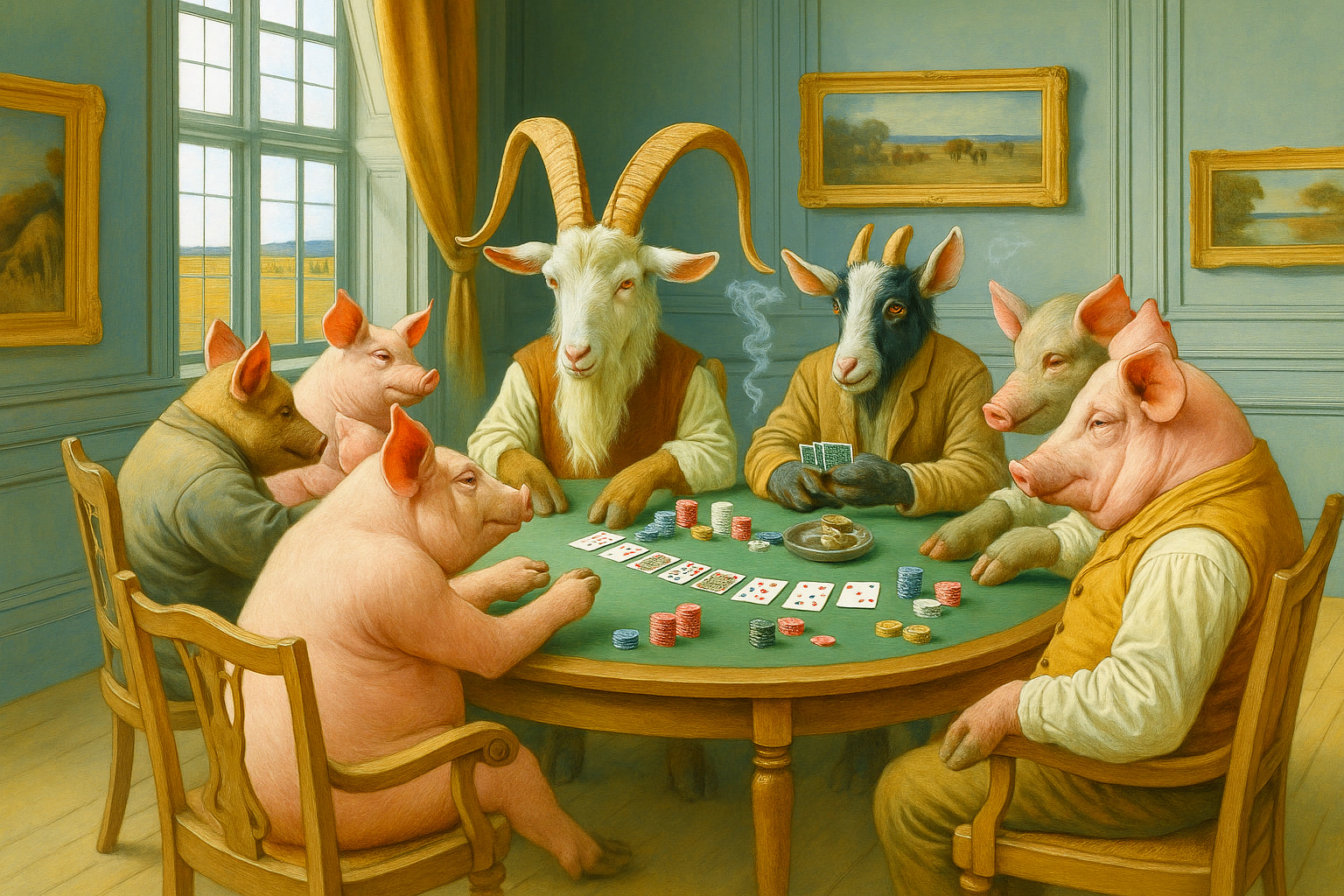
Here is an old GPT-image-1 image:
In the blue drawing room of Briarbell Manor, where the curtains were gold, the portraits were gloomy, and the floorboards creaked like elderly philosophers, seven gentlemen gathered every Thursday evening for the most serious card game in the county.
The gentlemen were, in strict order of arrival and increasing suspicion, Lord Bristleham the pig, his cousin Porkington, young Squealerby, the twins Hamuel and Gruntford, Sir Gruffington the white goat, and Captain Nibbles, a black-and-white goat with the steady glare of a judge who had once swallowed the evidence.
They played at a green felt table beneath expensive landscape paintings, though none of them had ever shown much interest in landscapes unless the grass was edible.
Sir Gruffington sat at the head of the table, his magnificent golden horns curling upward like two questions that had grown tired of waiting for answers. He had a beard so noble that even the dust motes behaved politely around it. In front of him sat a neat stack of chips, a pair of cards, and the expression of an animal who knew exactly how to win without seeming to know what rules were.
Captain Nibbles, across from him, held his cards close to his chest. A small curl of pipe smoke drifted beside his face, though nobody had seen him light a pipe. This was typical. Captain Nibbles had a reputation for producing atmosphere whenever the stakes rose.
“I raise,” said Captain Nibbles.
Six sets of ears twitched.
Lord Bristleham, a large pink pig in a yellow waistcoat, blinked slowly. He had been seated on the right side of the table for three hours, maintaining the look of a creature who had either calculated the odds to perfection or forgotten why he was indoors.
“Raise what?” asked Bristleham.
“The stakes,” said Captain Nibbles.
“Ah,” said Bristleham. “For a moment I hoped it was the buffet.”
A nervous rustle traveled around the table. The buffet had been discussed earlier and dismissed by Sir Gruffington as “a dangerous distraction.” This had nearly caused a constitutional crisis.
Outside the tall windows, fields of wheat glowed in the late afternoon sun. Inside, the room smelled faintly of waxed wood, old velvet, pipe smoke, and ambition. Coins and chips lay in little piles before each player. Cards were spread across the felt in a tidy line, the red hearts and diamonds shining like tiny accusations.
Young Squealerby, the smallest pig at the table, peered over his cards. He was new to the game and still believed that a straight was something one walked in before smelling truffles. His uncle Porkington had promised to teach him poker, but Porkington’s strategy consisted mainly of sighing heavily whenever he had a bad hand and sighing more heavily whenever he had a good one.
“I call,” said Porkington, tossing in two red chips with heroic gloom.
“You always call,” whispered Hamuel.
“And yet,” said Porkington, “nobody ever answers.”
Sir Gruffington lifted one hoof and tapped the table. The room fell silent. Even the smoke seemed to stand at attention.
“Gentlemen,” he said, “we have arrived at the final hand. The winner takes the pot, the silver platter of oat biscuits, and the title of Master of the Green Table.”
At the mention of oat biscuits, every pig at the table became visibly more intelligent.
The hand had begun innocently enough. A few cards, a few chips, a few dignified snorts. But then Captain Nibbles had raised, Porkington had called, Hamuel had mistaken the discard pile for his napkin, and Bristleham had attempted to bet his chair. By the time Sir Gruffington declared the final round, the pot contained chips, coins, two buttons, a bent spoon, half a cigar, and one written promise from Gruntford reading, “I owe the table three excellent potatoes.”
Gruntford, who had written the note, was proud of it.
“They are very good potatoes,” he said.
Nobody doubted him.
Captain Nibbles placed another stack of blue chips into the center. His eyes gleamed. Sir Gruffington watched him carefully. Bristleham watched the biscuit platter. Squealerby watched everyone else and wondered whether poker involved more staring than mathematics.
“I raise again,” said Captain Nibbles.
This was scandalous. In Briarbell Manor, raising twice in one hand was considered bold, raising three times was considered vulgar, and raising while smiling was grounds for writing a letter to one’s aunt.
Sir Gruffington did not smile. He simply pushed a tower of red chips forward.
“I see your raise,” he said, “and I add the biscuit platter.”
A gasp went around the table.
Lord Bristleham clutched his waistcoat.
“You cannot wager the biscuits,” he said. “They are innocent.”
“They are delicious,” said Sir Gruffington. “That makes them relevant.”
The gold-framed paintings looked down from the walls, pretending not to be entertained. The long yellow curtain shifted beside the window as if the evening breeze itself had leaned in to hear the result.
One by one, the players revealed their cards.
Hamuel showed a pair of threes and a playing card from an entirely different deck. Porkington displayed three queens and the mournful expression of someone who had expected more from royalty. Squealerby proudly laid down four cards before being gently informed that poker required five.
Bristleham revealed a flush. It was respectable, dangerous, and almost certainly the strongest hand he had ever held without trying to eat it.
“Beat that,” he said, leaning back with satisfaction.
Captain Nibbles spread his cards with theatrical calm. Four kings.
The table erupted.
“Four kings!” cried Porkington.
“Monarchy has gone too far,” muttered Gruntford.
Captain Nibbles nodded, already reaching for the pot. But Sir Gruffington had not moved. The old goat’s amber eyes narrowed. His great horns caught the sunlight from the window and gleamed like polished trophies.
“A fine hand,” said Sir Gruffington.
“Thank you,” said Captain Nibbles.
“But not fine enough.”
With exquisite slowness, Sir Gruffington placed his cards upon the table.
Ten. Jack. Queen. King. Ace.
All hearts.
For a moment, nobody breathed. Then Squealerby whispered the words that would be repeated in taverns, barns, and vegetable markets for years to come.
“That is a very organized set of cards.”
Sir Gruffington had won with a royal flush.
Captain Nibbles stared at the cards. Bristleham stared at the biscuits. Porkington stared into the distance, perhaps at destiny, perhaps at dinner. The smoke beside Captain Nibbles curled into a shape that looked suspiciously like a question mark.
“Well played,” said Captain Nibbles at last.
“Naturally,” said Sir Gruffington.
He reached for the silver platter. The oat biscuits shone in the lamplight. Victory was his. Glory was his. The title of Master of the Green Table was his.
Then, with the speed of a pink thunderbolt, Lord Bristleham leaned forward and ate one biscuit.
Everyone froze.
“Bristleham,” said Sir Gruffington, very quietly.
“Yes?” said Bristleham, crumbs on his snout.
“That biscuit was part of my winnings.”
“Indeed,” said Bristleham. “And I congratulate you. It was excellent.”
There are moments in history when great leaders choose mercy over wrath, diplomacy over conflict, and tea over shouting. Sir Gruffington looked at Bristleham, looked at the remaining biscuits, and made the only decision worthy of his horns.
“Very well,” he said. “The biscuits shall be divided among the table.”
The room burst into cheers, snorts, bleats, and one emotionally complicated cough from Captain Nibbles. The cards were gathered. The chips were counted badly. Gruntford’s promise of three excellent potatoes was accepted as legal tender for the next game.
Outside, the sun sank lower over the fields. Inside, Briarbell Manor glowed with warmth, mischief, and the satisfied silence of animals who had discovered that winning was pleasant, but sharing biscuits was better.
And from that evening onward, the Thursday game continued exactly as before, except for one important change: the biscuit platter was placed at the center of the table before the cards were dealt, guarded by all players equally, and watched most closely by Lord Bristleham, who maintained, to the end of his days, that he had not stolen a biscuit.
“I merely tested the prize,” he would say. “For fairness.”
No one believed him. Naturally, they invited him every week.
Love it! This is how it should be. Use what you like, learn from it and use it when you create cool stuff!
There’s also: Did you know that your interactive story GPT within ChatGPT is now completely broken and useless, because an image creation model takes over at the slightest hint and cannot return language, and the model will refuse to produce “preamble” for you, as before with its occasional imagery tool call behavior in the past after story, that is now not powered by a “dall-e” checkbox?
So there is “did you know you can create stories” with images.
I suppose one could “play” an adventure with an image model that can write text - if you, as free user, can tolerate just two images over four minutes before it says, “try again tomorrow”, the dumb GPT AI dead-ending “sorry” when it continues to call the image creator tool after an exhausted ChatGPT user quota.
Or, if you can pack knowledge and get a cohesive story in 16000 characters of API context, or have something else orchestrate the story, you might have an interactive graphic novel if 100 token images could be made instead at 100 tokens per second.
For the better part of last month and occasionally still, standard prompt requests using only text would often open up the image shell and would reason out the request just above it.
It then shuts down the image shell because no actual image is coming and then replies… presumably after using that image space to maybe map out its thinking chain?
There’s a toggle on the bottom that requests an image be made from the prompt, and in the cases that fall in the above bucket, that was not pressed.
However, if I accidentally have the generate image request toggled on, and the prompt is clearly for an answer rather than a picture…
This will net a reasoning chain of text that explains how it’s still forced to produce an image and generally won’t be chatty at all…
That’s the only behavior I can confirm from this sort of access, it certainly does force itself over the model’s response.
I would totally agree. But most of this “free usage” ain’t actually free. Even though for many it should be like that, a free tier that doesn’t bring revenue is more like invitation to come the the pay plans.
With the rising boom of AI, infrastructure is getting super expensive. I see it at work too. So, free use tiers, if nothing changes, will start to dwindle.
On the other hand, if you check the trends for end-consumers at Computex 2026, super cheap affordable good home computing is actually coming. It’s a very high dynamic market out there.
Also don’t blame code, it’s like blaming the wall for having your shadow on a sunny day.
I know there are people out there who did count in those limited numbers…
I didn’t get a subscription till after about 3 months after posting in the previous iteration of this thread…
I would take time to try and make the prompts the most valuable because it was quite possible to not have something really worth submitting to the pile of talent we’re growing…
I try not to say free account because it feels like it generates tension…
But my secret’s out now.
Entry invitational tier with compelling arguments to not leave!
(API keys are stored, but only in your browser’s local storage. API calls are made direct to OpenAI.)
That’s with 0 additional human tuning for the API.
Then turn the individual chat turn assistant outputs into images:
You are an interactive fiction experience creator.
You transform the language output from an AI model that conducts a choose-your-adventure chat into images that contain the same chat turn's message with added imagery. The language may need to be compacted to fit the image format, as the final deliverable the user sees when playing the interactive fiction is *only* your images.
---
## Image contents
````AI turn
...
200 pages for a buck at “low”.




 as a prompt (storytelling(ish)) plus magical octopus and ta-da


